.svg)
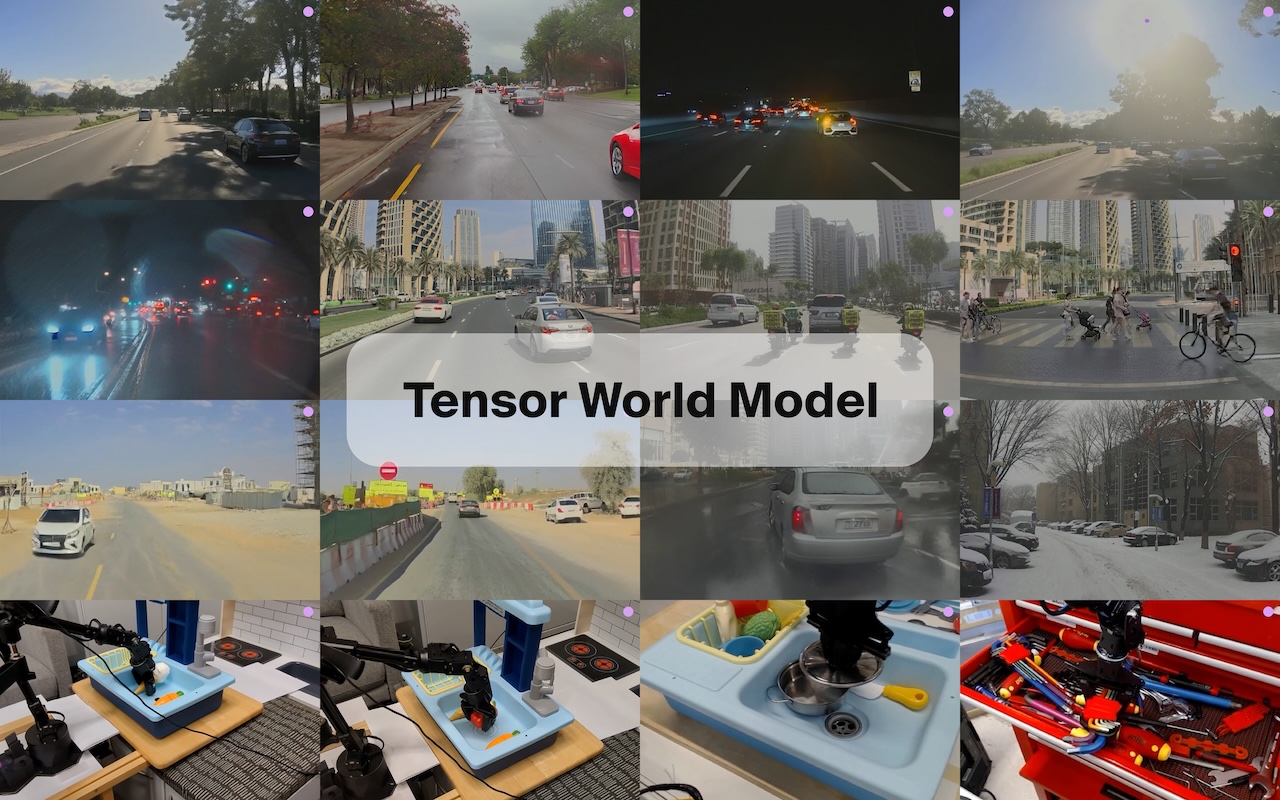
Physical AI is the next frontier of Artificial Intelligence: systems that can perceive the physical world, reason about it, and take actions within it through machines such as self-driving cars and robots.
At Tensor, we are building large foundation models for Physical AI. Recently, we open-sourced OpenTau, a training toolchain for frontier vision-language-action (VLA) models that jointly reason over visual inputs, natural language, and action outputs. These models move beyond perception alone. They help AI systems understand their environment, interpret intent, and act within the world.
But model capability is only part of the equation. Performance is ultimately tied to data. And in the physical world, high-quality data is expensive to capture, curate, and label at scale.
That is where world models become essential.
For the past ten years, Tensor has been developing its autonomous driving system, with testing across dozens of cities in the United States and around the world. Alongside real-world road experience, our self-driving system has also logged billions of miles in virtual environments, learning from complex scenarios long before encountering them on public roads.
Powering this effort is Tensor World Model — a frontier generative model that sets a new bar for large-scale, hyper-realistic autonomous driving validation.
Built as an end-to-end world foundation model platform for Physical AI, Tensor World Model can take text, image, or video prompts and generate virtual world states as video. This enables us to create photorealistic, physically grounded synthetic data across a wide range of environments, objects, weather conditions, times of day, and rare edge cases.
In one example, we begin with a short segment of real driving footage in California captured by our self-driving cars. We then ask Tensor World Model to generate the next sequence of world states conditioned on that input. In the visualization, a purple dot in the top-right corner indicates the moment when the footage transitions from real-world video to AI-generated continuation.
The result is not simply visual imitation. It is a model of how the world evolves.
One of the most powerful capabilities of Tensor World Model is its ability to generate visually and behaviorally challenging scenarios that are difficult and costly to capture at scale in the real world.
For example, nighttime traffic can be synthesized by conditioning on a nighttime driving segment. Changing the time of day also changes the position of the sun, placing the camera directly into harsh sun glare on a California road. These conditions allow us to evaluate perception robustness, scene understanding, and driving performance in situations that are rare, safety-critical, or expensive to collect in sufficient quantity.
The model can also generate hyper-realistic environments under a wide range of weather conditions. A rainy evening drive through a California neighborhood, for instance, becomes a controllable testbed for understanding how weather affects visibility, road appearance, and downstream driving behavior.
By generating these edge cases in simulation, we can stress-test the system far more efficiently than relying on opportunistic collection alone.
Tensor World Model also helps us extend autonomous driving capabilities far beyond the geographies where data was originally collected.
Consider Dubai, where driving environments and traffic behavior can look dramatically different from California. The streets are filled with fast-moving interactions: food delivery motorcyclists weaving through dense traffic, continuous vehicle flow, crowded urban centers, and road networks that span downtown towers, suburban neighborhoods, and open desert.
Tensor World Model allows us to recreate these complex urban driving scenarios in simulation at scale.
That includes:
Why simulate the impossible? Because preparing autonomous systems only for the common case is not enough. Robust self-driving requires understanding how the system behaves in the rarest, strangest, and most safety-critical scenarios imaginable.
World models give us a way to do that proactively.
While Tensor World Model is already a powerful tool for autonomous driving, its scope extends much further.
This is not just a driving simulator. It is a general-purpose world model capable of generating photorealistic, interactive 3D environments. That makes it relevant across a broader class of Physical AI systems, including robotics.
The same capabilities that help a self-driving system model traffic, predict motion, and reason about physical interactions can help robots operate more effectively in human environments.
In a kitchen, that could mean learning to grasp objects, organize items, clean surfaces, and assist with everyday chores. In a garage, it could mean recognizing a toolbox, selecting the right tool, and handing it over at the right moment. In both cases, success depends on a rich internal model of how the physical world behaves: how objects move, how environments change, and how actions lead to outcomes.
Tensor World Model benefits from strong world knowledge developed through pretraining on an extremely large and diverse corpus of internet-scale video data. This broad exposure helps the model better predict physical dynamics, scene evolution, and object interactions across many settings.
That is a core requirement for Physical AI.
As AI systems move from the digital world into the physical one, the bottleneck shifts. The challenge is no longer only language understanding or visual recognition. It is building systems that can safely and reliably operate in dynamic, uncertain, real-world environments.
That requires more than task-specific datasets. It requires scalable ways to model the world itself.
World models offer that path. They can generate diverse training and validation environments, expose systems to long-tail conditions, and create realistic scenarios before those scenarios are ever encountered in the real world. They help bridge the gap between limited physical data and the broad competence needed for autonomy.
For self-driving, that means safer and more capable autonomous systems. For robotics, it means more reliable physical reasoning and execution. For Physical AI as a whole, it means moving from narrow capability toward general, embodied intelligence.
Tensor World Model is part of our broader effort to build foundation models for Physical AI — from training infrastructure like OpenTau to world models that scale learning, validation, and deployment in the physical world.
We believe the future of AI will be built not only on models that understand text or images, but on models that understand how the world works.
This is how we move Physical AI forward. And this is how we help bring safer, more capable autonomous driving to the world.


Sign up to get the latest news, announcements and
updates direct to your inbox.
.webp)


.svg)


