.svg)
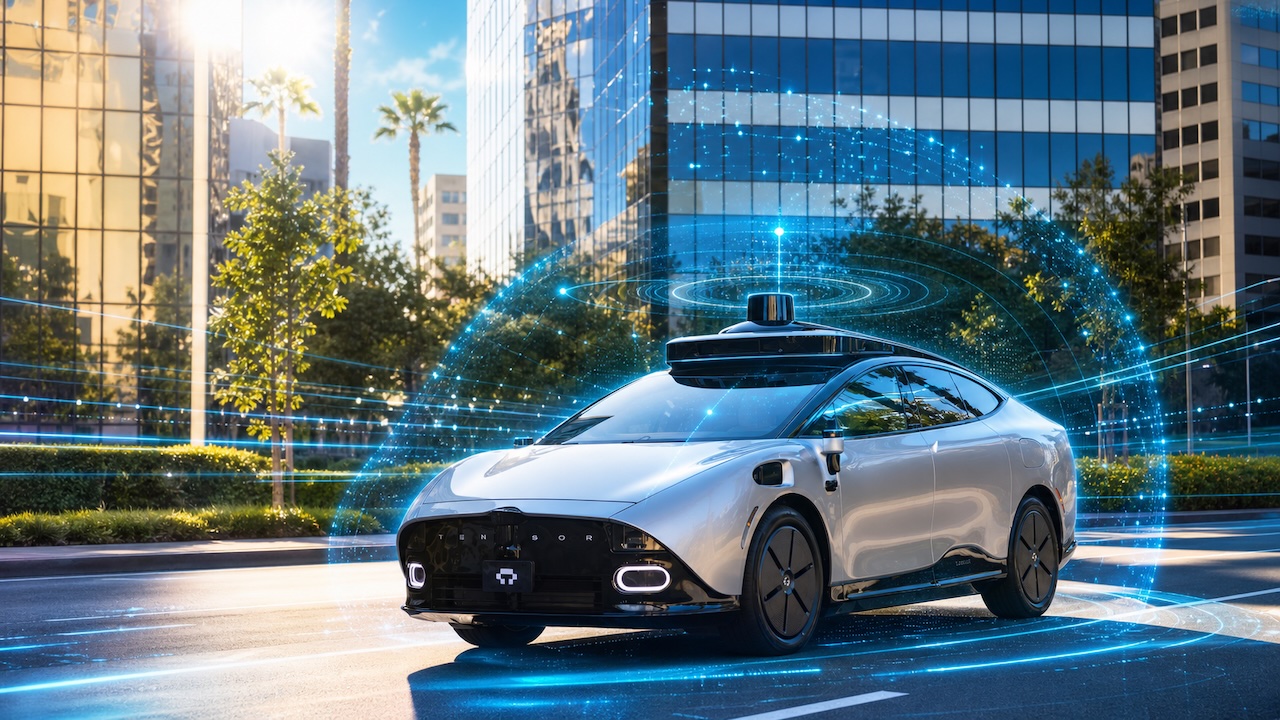
When people think about Level 4 autonomous vehicles, they usually envision powerful sensors, real-world perception models, and complex neural networks. But as vehicles transition into autonomous robots operating on public roads, another critical challenge emerges: cybersecurity.
In a world where software controls steering, braking, and navigation, a vehicle’s cybersecurity architecture isn't just an IT consideration—it is fundamental to human safety and data privacy.
Today, we are excited to share a major milestone in our journey: Tensor has officially achieved full compliance with ISO/SAE 21434, the global gold standard for road vehicle cybersecurity engineering. Validated through an independent audit by leading European homologation authority Applus+ IDIADA, Tensor achieved a flawless result with zero findings or non-conformities.
Here is why this achievement matters—not just for global regulatory compliance, but for the future of consumer-owned Physical AI.
Most legacy automotive systems and B2B robotaxi fleets rely heavily on continuous cloud connectivity. They stream massive amounts of sensor data back to corporate servers and depend on external telemetry to validate decisions.
The Tensor Robocar takes a fundamentally different approach. Designed from the ground up for private, consumer ownership, the Robocar processes perception, trajectory planning, and biometric authentication natively on the vehicle using its high-performance onboard supercomputing stack.
“In the era of Physical AI, cybersecurity isn’t just about protecting software—it’s about safeguarding personal agency. While legacy automakers build connected vehicles that continuously stream data back to corporate clouds, the Tensor Robocar is engineered to answer solely to its owner.”
— Dr. Jay Xiao, Founder & CEO of Tensor
Our edge-first, zero-trust architecture ensures that your personal Robocar remains completely unhackable and fully functional without requiring persistent connectivity or sacrificing user privacy.
Passing an ISO/SAE 21434 audit with zero non-conformities means our Cybersecurity Management System (CSMS) was verified across every stage of our engineering and organizational pipeline:
Beyond validating our engineering rigor, ISO/SAE 21434 compliance provides a strong foundation for meeting the cybersecurity and CSMS requirements of UN Regulation No. 155 (UN R155). UN R155 mandates cybersecurity compliance for vehicle type approval in over 60 countries across the European Union, the UK, Japan, and South Korea.
As we prepare to bring the Tensor Robocar to international markets, this clean audit confirms that our software, hardware, and organizational processes satisfy the world's strictest automotive regulatory mandates.
The future of mobility isn’t just about making vehicles autonomous—it’s about making them safe, private, and truly personal. With a validated zero-trust security foundation, Tensor is proud to lead the way toward consumer-owned Physical AI.


Sign up to get the latest news, announcements and
updates direct to your inbox.
.webp)


.svg)


